
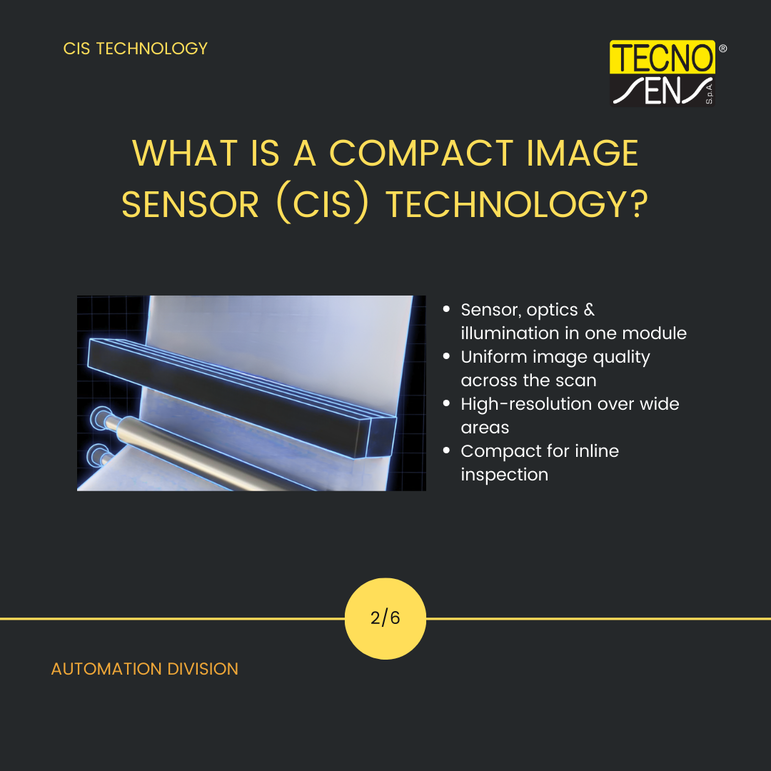
Compact Image Sensors (CIS) are advanced linear imaging systems designed for high-resolution, uniform, and compact inspection.
Unlike traditional camera-lens systems, CIS technology integrates sensor, optics, and illumination into a single compact module, ensuring consistent image quality across the entire scan width.
Key advantages
-
Extremely compact design
-
Uniform illumination and focus
-
High resolution across wide inspection areas
-
Ideal for inline industrial inspection
Why CIS for Industrial Inspection?
Designed for Precision and Stability
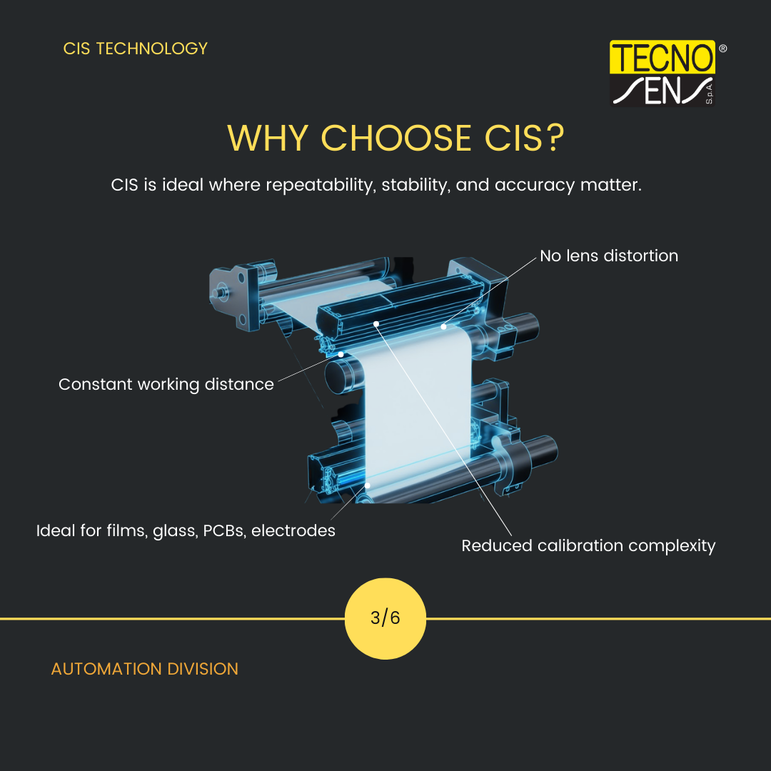
CIS technology is widely used in industrial environments where repeatability, stability, and accuracy are critical.
Main benefits
-
No lens distortion across the field of view
-
Constant working distance
-
Reduced calibration complexity
-
Excellent performance on flat materials (films, glass, electrodes, PCBs)
CIS systems are particularly effective in Web, surface inspection, and defect detection applications.

CIS vs Traditional Camera Systems
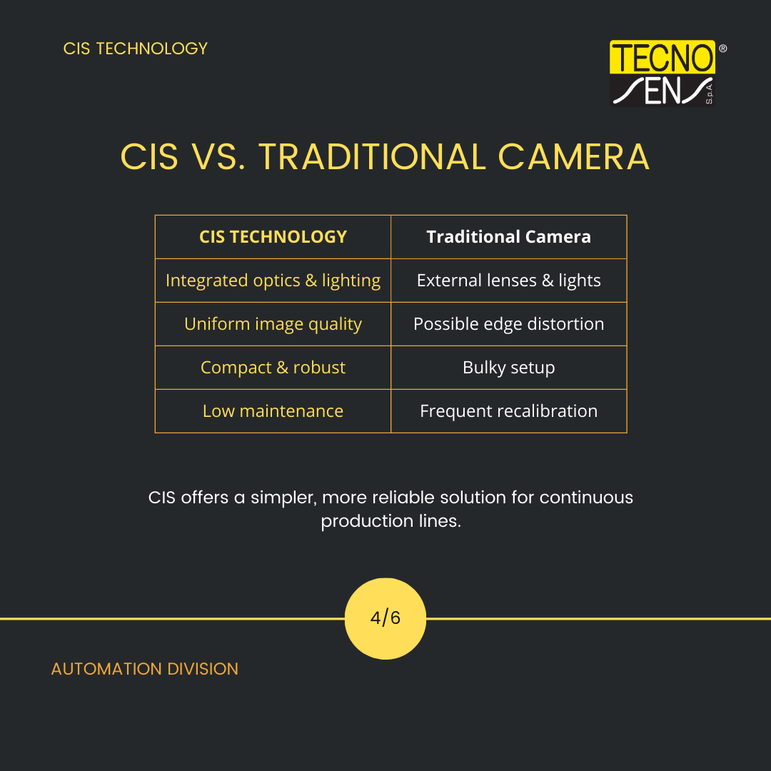
Compact vs Lens-Based Imaging
|
CIS TECHNOLOGY |
Traditional Camera |
|
Integrated optics & lighting |
External lenses & lights |
|
Uniform image quality |
Possible edge distortion |
|
Compact & robust |
Bulky setup |
|
Low maintenance |
Frequent recalibration |
CIS offers a simpler and more reliable architecture, especially for continuous production lines.
Why CIS Changes the Game
Less complexity. More consistency. CIS technology simplifies industrial vision systems by design.
What do customers really gain?
-
Faster system integration
-
Reduced footprint on the production line
-
Lower maintenance and recalibration effort
-
Stable image quality over time
A smarter way to build reliable inspection systems.