Glass, with both flat and curved surfaces, is an essential material for the automotive sector and the construction industry. For years, the control of glass products shapes has relied on contact-based measurement tools, such as LVDT probes. Reliable and robust, these probes have represented the industrial standard, ensuring good repeatability in measuring dimensions and displacements.
However, contact-based solutions with moving components have significant limitations: probe wear, longer measurement times, and difficulties in measuring particularly delicate surfaces without causing damage.
Technological evolution has led to the development of optical measurement systems, capable of detecting critical parameters without physical contact.
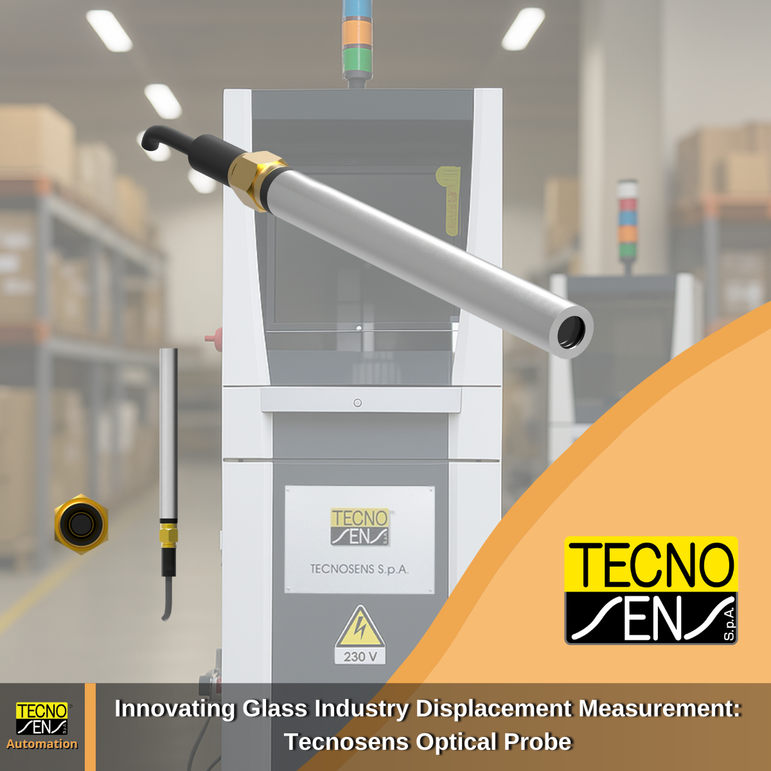
In this context, Tecnosens introduces an innovation: a non-contact Optical Probe with a diameter of only 8 mm, developed for both flat and curved glass control and ideal for reflective targets.
Thanks to its patented optical technology, the probe represents a decisive step forward from traditional approaches.
The new probe allows high-speed measurements of key parameters: distance, slope and thickness, even on complex glass such as windshields and special construction panels.
Its compact size and high accuracy make it ideal for integration into automated production lines, where maintaining high quality control standards without slowing down processes is crucial.
To meet these requirements, Tecnosens offers the complete Caliber system for measuring automotive glass curvature. This advanced solution analyzes the shape, curvature and perimeter of both flat and curved glass, designed to meet the most demanding requirements of the automotive industry and beyond.
The Caliber system integrates both non-contact optical sensors and LVDT contact transducers, allowing measurements to be adapted to the client’s needs while ensuring speed, accuracy, and reliability.
The real breakthrough, however, lies in the use of the new optical probe, which provides substantial benefits compared to traditional LVDT transducers: the absence of mechanical movement and wear simplifies maintenance and ensures higher reliability and longer operational life; setup is faster due to the elimination of pneumatic tubes and fittings; and the lack of contact with the glass allows measurements on even the most delicate surfaces.
A further comparison can be made with confocal sensors. While these systems provide precise measurements, they have certain limitations: the fiber optic cable connects the probe to the electronics, while the probe body contains only a set of lenses. This setup results in higher initial costs and expensive replacements in case of fiber damage. Tecnosens optical probe overcomes these limitations with a simpler and more robust design: it uses a single connector and keeps both lenses and electronics protected within the probe body. This reduces maintenance costs, increases reliability, and simplifies integration into industrial systems.
The system can be used both in-line and off-line, providing a significant quality boost to the production process. It drastically reduces inspection times, ensures full traceability of each measurement, and helps raise overall quality standards, while offering the flexibility needed to meet both testing and sampling requirements as well as full integration into automated production lines.
Applications are numerous: from automotive and safety glass to industrial vehicle glass, and even specialty glass and shower enclosure panels.
This combination of innovation, quality, and flexibility makes the Caliber system a strategic solution not only for large manufacturers but also for smaller-scale operations, allowing them to benefit from advanced measurement tools without compromising productivity. Reliability, easy configuration, and full data traceability have consolidated, for over twenty years, the trust of the world’s leading automotive glass manufacturers, confirming Tecnosens as a reference partner for precise and efficient measurement solutions.