
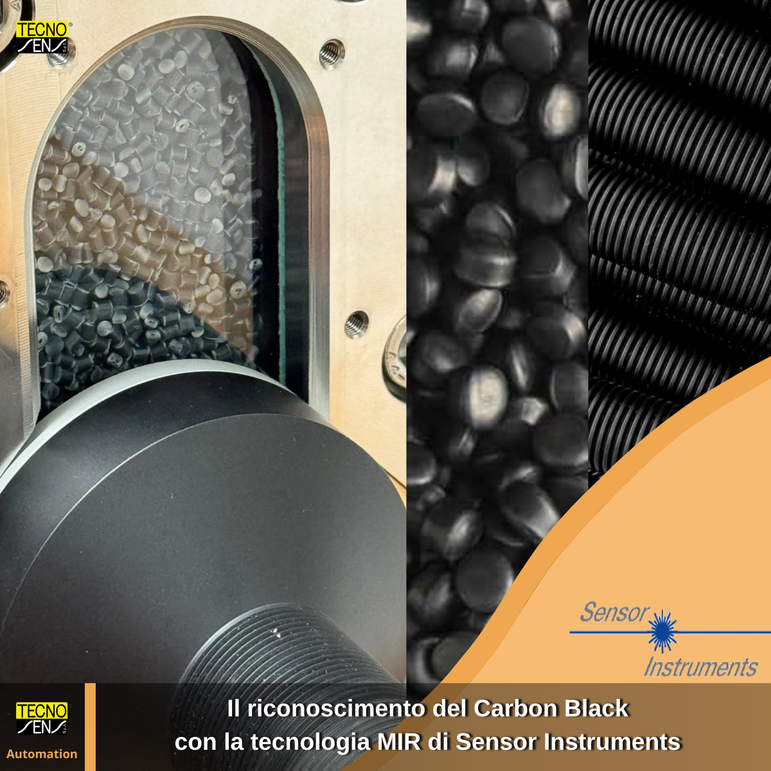
Recognition of Carbon Black Plastics in Recycling
Recycling plastics containing carbon black is a crucial challenge for modern industry. These materials, widely used in the automotive, electrical, and construction sectors, can compromise the quality of Secondary Raw Materials (SRM) and interfere with extrusion processes if not precisely detected. Carbon black makes black plastics nearly invisible to traditional sorting systems due to their particular light absorption behavior. To address this issue, Sensor Instruments has developed sensors based on MIR technology (mid-infrared, 2.5–25 µm), capable of detecting even the smallest contaminations.
Sensor Instruments’ sensors employ the “3 range” method (L–C–R), a proprietary methodology similar to the concept of color measurement in Lab* scale, where a sample is described by three numerical values defining its position in the color space. In the case of MIR sensors, however, it is not visible color being measured, but the absorption of light in the mid-infrared spectrum.
How MIR Sensors Work
-
The MIR light is emitted by a source covering the 2.5–5 µm range.
-
On the receiving side, only a specific portion of the spectrum passes through a band-pass filter.
-
The signal is then divided into three distinct MIR spectral ranges: L (Left), C (Center), and R (Right). For each sample, a triple Mir* value is obtained, representing its characteristic “spectral fingerprint.”
Each type of plastic absorbs MIR light in slightly different ways. Even black plastics, nearly invisible to traditional optical systems, show measurable differences in the MIR range. Thanks to this technology, even the most difficult-to-detect black plastics become manageable, enabling the recycling industry to produce reliable materials for critical applications.
The 3 range method enables:
-
Differentiation between different types of black plastics;
-
Detection of very small impurities or contaminations, as the spectral fingerprint changes in the presence of foreign materials;
-
Quality monitoring of recycled materials both in the laboratory and in production lines.
This approach makes it possible to control materials at every stage, ensuring stable and reliable SRMs.
MIR sensors ensure quality control at every critical stage of the recycling process, distinguishing between different types of plastics and enabling the production of high-quality recycled materials. The main stages of application include:
-
Shredding and washing: identify different types of plastics, allowing for accurate sorting at the very beginning of the process;
-
Extrusion: check for the absence of residual impurities on the vibrating conveyor, ensuring the purity of the recycled material;
-
Dosing for injection molding: continuously monitor the material flow, detecting any deviations in real time.
The most common black plastics detectable with MIR sensors vary depending on the sector:
-
Automotive: PP, PUR, ABS, PVC, and PC are valued for versatility, strength, and lightness;
-
Construction: PVC, PUR, PP, PE, and EPDM are chosen for durability, insulation, and impermeability;
-
Electrical: ABS, PA, PBT, PC, and TPU are used for UV resistance, insulating properties, and robustness.
This solution can be applied in laboratories, using silos or containers, or in mobile mode for quick checks across different production lines. Portable devices and dedicated software allow real-time visualization of trends and numerical values, improving quality control and data traceability.
Adopting MIR technology provides numerous concrete benefits: reduced waste, defect prevention, optimized production efficiency, and guaranteed high-quality SRMs.
In a context where sustainability and the quality of recycled materials are becoming increasingly strategic, the precise recognition of carbon black represents a key element for an efficient and responsible circular economy.